DELANEY & BONNIE: ON TOUR WITH ERIC CLAPTON DJ/MONAURAL COPY (CD)
$35.00
JAPANESE RELEASE – CD
Description
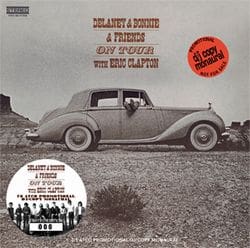
DELANEY & BONNIE ON TOUR WITH ERIC CLAPTON: DJ/COPY MONAURAL (1CD)
Taken from the original US ATCO PROMOTIONAL DJ/COPY MONAURAL (ST-C 13295/6 PR)
[An exquisite reproduction of the world’s only extremely rare monophonic DJ sample LP!]
This week, as part of our “Ultra Rare Reissue” project for Eric Clapton, we are releasing an extremely rare mono DJ sample LP that was produced in America in 1970 in extremely limited quantities and distributed exclusively to radio stations. This work is a CD version of the DJ sample mono version of the live album “Delaney and Bonnie and Friends on Tour with Eric Clapton,” released in America in 1970.
In the late 1960s and early 1970s, records and radios were the common means of listening to music in the home. However, stereo records were just beginning to appear, and mono playback was still the norm. Radio, reflecting this trend, was dominated by mono broadcasts, and this album was only released as a stereo LP in the US and UK. However, in the US, the ATCO label made the effort to produce a very limited number of mono records suitable for radio station mono broadcasts and distributed them to radio stations across the US. This meant that these records were never sold. However, over the years, radio station staff and associates who were clearing out their inventory occasionally began to sell them on the used market. Naturally, as a limited edition, non-saleable record, it continues to fetch premium prices on the used market to this day. As the years go by, these records have become increasingly rare, and prices continue to soar. This time, we borrowed a DJ sample mono recording of “Delaney and Bonnie and Friends on Tour with Eric Clapton” from a veteran rock fanatic, and using high-end analog and digital equipment, we have created a CD that is faithful to the original recording.
Looking at the actual record, the jacket is labeled “stereo” (meaning they couldn’t afford to produce a mono jacket, so they used the standard version’s jacket), but it has a sticker that reads “dj/copy monaural.” The record label is white and features the Atco mark, the title, the tracklist, and “SAMPLE COPY NOT FOR SALE.” This is a mono-only release, lacking the “SD” prefix typically found at the beginning of the label number. The matrix numbers for the dj/copy monaural version are “ST-C-13295 PR/STC-C-13296 PR,” completely different from the standard PR factory pressing/stereo version’s “ST-C-701831 PR/ST-C-701832 PR.” Because the mono version was manufactured using a completely different process than the standard version, it’s incredibly rare and has never been released on CD before.
As a vintage disc, there was a noticeable amount of needle popping during the CD release. However, applying needle pop removal to the entire disc would have affected the sound, so only the most noticeable areas were carefully pinpointed and corrected. There are also several areas of apparent distortion, but adjusting the needle pressure on the high-sensitivity cartridge did not improve the sound, so we left them as they were (this is not due to excessive input during digital conversion). Furthermore, at 5:55 during “Comin’ Home,” there is a drop in sound only in the right channel, but this was left as it was, as it was likely due to the master recording. This mono disc, once only available on American radio, can now be easily listened to on CD in the best possible environment today. Why not take a time leap with this release and experience a time leap back to the homes of those who listened to the radio in America in the 1970s?
[About Delaney & Bonnie]
For those of you who have never heard of the artist name “Delaney & Bonnie,” let’s briefly explain what kind of artists they were. Delaney Bramlett (born 1939), who played guitar and vocals in the house band for the nationally televised live music show “Shindig” based at a Los Angeles television station in the 1960s, met Bonnie Lynn (born 1944), who was a member of Ike and Tina Turner’s backing vocal group, the Ikettes, and they married within days. Delaney, a Mississippi native steeped in blues and soul, and Bonnie, the soulful singer who was the first white person to be hired by the Ikettes, must have hit it off perfectly. The two assembled a backing band of talented studio musicians and began performing as a group, steadily releasing albums. The band also featured Jerry McGee (guitar) and Jim Keltner (drums) at one point, and Dave Mason, influenced by them, also traveled to the US and played in the band for a time (he was Clapton’s predecessor). George Harrison, who visited the US in the late ’60s, was so moved by a Delaney & Bonnie performance at the Snoopy Club in LA that he told his close friend Clapton about them after returning home. Then, in 1967, while on an American tour with Cream, Alan Palliser, an industry insider, played Clapton a tape of The Band’s “Music From Big Pink.” He then sent Clapton a test pressing of Delaney & Bonnie’s “Accept No Substitute.” Palliser was Delaney & Bonnie’s manager at the time. Clapton was so impressed by the recording that he immediately booked them as the opening act for Blind Faith’s upcoming US tour. This was in 1969. After seeing them perform on tour, Clapton began spending more time with Delaney & Bonnie’s band than with his own bandmates. After Blind Faith disintegrated after the tour, Clapton began working with Delaney & Bonnie. Clapton, a superstar who had achieved fame with Cream at the time, was captivated by this unknown band, who opened for Blind Faith, and their earthy, bluesy, and soulful music, despite the band’s white members, and the family-like bond between the band members. After recording two singles with them, Clapton, at Delaney’s request, officially joined the band. He planned and implemented a tour to introduce them to Europe. The live album “Delaney & Bonnie & Friends On Tour With Eric Clapton” was recorded and released during that UK performance. Clapton continued to work with them into 1970, and at Delaney’s urging, he recorded his first solo album, which Delaney produced. Although they broke up in 1972, their best-selling album was “Delaney & Bonnie & Friends On Tour With Eric Clapton,” so it can be said that they and Clapton were comrades who worked together through a turbulent time. It was Delaney & Bonnie who revolutionized Clapton’s career and breathed new life into British rock with blue-eyed soul.
[About this album]
While this period in Clapton’s career was relatively low-key (the transitional period between Blind Faith and the formation of Derek and the Dominos), it could also be described as a period of self-improvement and training in the real world. The tour Clapton planned and organized for them kicked off in Germany in late November, but for the UK tour in December, Clapton’s predecessor, Dave Mason, joined them. Because the UK tour was close to Clapton’s residence where the band was staying, Clapton even suggested that his close friend George Harrison be almost kidnapped and forced onto the tour bus to join him. This album primarily features live recordings from December 7, 1969, at Fairfield Hall in Croydon, England, with the exception of “I Don’t Want to Discuss It,” which features a December 2nd recording at Bristol’s Colston Hall. The guitarist is particularly noteworthy. At one point, the band featured as many as four guitarists onstage: leader Delaney Bramlett, Eric Clapton, Dave Mason, and George Harrison. George Harrison’s participation was famously denied due to copyright issues, as he was on a different label than the others. He was credited on the back cover of the album under the pseudonym “Thanks to L’Angelo Misterioso” (this was the pseudonym George used when he played on Cream’s “GOODBYE”). George’s name was cleverly edited out during the MC introductions before the Little Richard medley and during Delaney’s introductions during the song.
Regarding the stereo mix, in the Croydon performance take, Clapton was mixed into the right channel, Mason into the left channel, and Delaney and George into the center channel (it’s easy to tell from Comin’ Home, where two slide guitars are mixed into the center, one of which is George). In the Bristol performance take, Clapton was mixed into the center channel (George did not participate in this performance). While these differences were easily distinguishable on the stereo version, how was the balance of the four musicians’ playing mixed into the center in this mono mix? This is surely a question of great interest to enthusiasts. Please check it out.
Listening to the mono mix, one is once again struck by the richness and power of the sound of this 12-piece band. Despite being unknown at the time, all members were first-rate musicians (it’s no wonder Clapton later wanted to form Derek and the Dominos with these members).
In other words, the band that performed on this stage was an all-star lineup, including Delaboni, George Harrison and Dave Mason, who would later become members of Derek & the Dominos, and Rita Coolidge, who would later become a member of the Stones’ horn section. Listen to the performance of this band, which, even though they weren’t very successful at the time, still shone with such brilliance. It almost feels as though the true essence of this band lies in this mono sound. This is the first CD release of this extremely rare, never-before-sold album!
(42:51)
1. Things Get Better
2. Poor Elijah – Tribute to Robert Johnson Medley
3. Only You Know and I Know
4. I Don’t Want to Discuss It
5. That’s What My Man Is for
6. Where There’s A Will There’s A Way
7. Comin’ Home
8. Little Richard Medley – Tutti Frutti/The Girl Can’t Help It/Long Tall Sally/Jenny Jenny