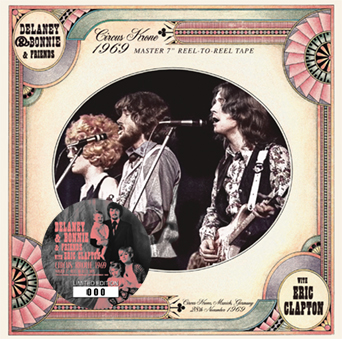
DELANEY & BONNIE & FRIENDS W/ ERIC CLAPTON – CIRCUS KRONE 1969 MASTER 7″ REEL-TO-REEL TAPE (CD)
$34.95
BEANO – CD
Description
Circus Krone, Munich, Germany 28th November 1969 TRULY AMAZING/PERFECT SOUND(from Original Masters)
★UPGRADE & PITCH ADJUSTED
[Previously unreleased master recordings of Delaney & Bonnie & Friends’ 1969 European tour, featuring Eric Clapton, have surfaced!]
When it comes to live recordings of Delaney & Bonnie & Friends during Eric Clapton’s time with the band, the official “DELANEY AND BONNIE AND FRIENDS ON TOUR WITH ERIC CLAPTON,” which captured their December 1969 UK tour, and its expanded 4CD box edition, as well as the video of their December 10, 1969 Copenhagen performance, are well-known. But now, a historically significant recording, previously unreleased in Japan, has surfaced!
This is a stereo audience recording of the Munich, Germany concert on November 28th of the same year, captured with sound quality that can be described as “superb” even by today’s standards. It was recorded using a 7-inch reel tape deck and an external microphone, which must have made it outstanding for a recording of that era. This astonishing master was provided by an overseas taper with whom our store has strong connections, and who has already gained a reputation for providing valuable and high-quality unreleased Clapton recordings.
While this is a superb stereo recording, it is, in a sense, a “historical discovery” due to the age-related deterioration of the original tape. There were random pitch inaccuracies and frequent dropouts in the left and right channels. However, in order to make the most of this precious “treasure” audio source, our engineers corrected the randomly inaccurate pitch as much as possible, and regarding the dropouts in the left and right channels, since hiss was present, adjusting the sound pressure would have made it sound unnatural, so we only adjusted the dropouts where it wouldn’t sound unnatural, making it easier to listen to. Some dropouts still remain, but the pitch inaccuracies have been almost completely eliminated, and it has been improved to a level where you can listen to it without stress. There are noticeable dropouts in the latter half of “Comin’ Home” and in the middle of “Don’t Want to Discuss It” due to the condition of the tape, but even then it returns to normal, so you can rest assured. Furthermore, while “I Don’t Want to Discuss It” is cut off at the end, Clapton’s solo in the middle section is still clearly audible, and since the cut-off occurs near the end of the performance, it should be acceptable to Clapton fans. Afterwards, there is someone’s voice (the recording engineer?), but we left it as is to respect the integrity of the master recording. Although there are some shortcomings due to it being a master from that era, this release is a significant upgrade from the original master by an overseas taper.
The most striking feature of this master is, above all, how Clapton’s playing resonates soaringly in the center-right channel! Behind him, the powerful drumming of technical drummer Jim Gordon and the masterful bass of Carl Radle provide solid support in the center channel. Furthermore, a sharp, piercing horn section is positioned slightly to the left of the center channel. And if you listen carefully, you can even hear Bonnie Bramlett’s wild tambourine playing and Tex Johnson’s congas. The vocals are also flawless. Clapton’s voice on “I Don’t Know Why” is clearly recorded. Listeners will surely be thrilled by this sound image. This recording appears to have been released on CDR overseas, but it seems that the pitch and sound quality issues were left as they were, so this release is the first in Japan and can be said to be of the highest quality.
[Rare audio recording capturing a controversial German tour!]
Superstar Eric Clapton was drawn to the earthy, soulful music and the close-knit, family-like bond of the band members of an unknown band that opened for Blind Faith. He cast aside his status and joined Delaney & Bonnie & Friends as a sideman. This was a period of great ambition for Clapton, a British-born white man, who saw in this band the true essence of white soul and white blues—a genre he felt he needed to master in the heartland of the blues. While relatively low-key in his career, it was a period of intense, solitary training in the heart of the music scene. To introduce them to Europe, Clapton personally organized a European and British tour from November to December 1969. Clapton wanted their music to be widely appreciated in Europe and Britain, but a major problem arose in Germany, the first stop on the tour. The local promoter advertised the show under the name “Eric Clapton & Friends” and sold tickets under that name (to boost ticket sales). For German Clapton fans, having only seen Cream in ’67, they understood this as Clapton finally returning with his own band after a two-year hiatus since Blind Faith. However, Clapton was merely a support guitarist for Delaney & Bonnie & Friends, so there was a huge disconnect between the performer’s perception and the audience’s.
At the Cologne concert the following day, the audience, disappointed by the disappointing content that didn’t live up to the promises, started making noise during the show, causing a temporary halt to the performance. Clapton even stepped up to the microphone and apologized, saying, “I’m not ready to sing yet. I’m sorry.” However, the Munich audience that day seemed to have neutral ears and hearts, and sincerely applauded the band’s powerful performance. When “I Don’t Know Why,” featuring Clapton’s vocals, was introduced, applause erupted, and more applause followed when Clapton began to sing. This song was included on Clapton’s first solo album, “ERIC CLAPTON,” released in August of the following year, 1970, but it seems to have been included in the setlist because it had already been recorded at Olympic Studios in London before this tour. The audience had bought tickets specifically to see Clapton, but the excitement didn’t stop at just this song; they were enthusiastic throughout the entire performance. In other words, Delaney & Bonnie captivated the audience with their performance itself.
Despite its short set, there are plenty of highlights. “Tribute to Robert Johnson” and “Get Ourselves Together” are arranged as a medley in a way not found on the official live album, and Clapton’s solo is a completely different improvisation from the official live album. The performance captures Clapton and his band giving their all in uncharted territory, Germany. Clapton was the only side guitarist on this occasion, a greater responsibility than the UK tour the following month when Dave Mason and George Harrison joined, but his excellent sense of obbligato and solos, and lively rhythm cutting are immediately apparent (Delaney Bramlett’s guitar is positioned in the center and easily distinguishable from Clapton’s).
Delaney & Bonnie’s tracks exude a swampy feel while also possessing a pop side with catchy melodies and chord progressions, a style that clearly had a significant influence on Clapton’s later career. Some Clapton fans may underestimate this band because it was a period when Clapton wasn’t actively leading, but I hope you’ll once again appreciate the essence of blue-eyed soul that Clapton was trying to master through this album. The sensibilities he honed here gave birth to the album “LAYLA.” Listen to Clapton’s dazzling playing, even though he was the unsung hero behind the scenes. It seems that the Little Richard Medley was played at the end of the set, and this nearly full set recording from the German tour is extremely rare, making it a shocking and historically significant discovery, being released in Japan for the first time. This live album is a must-see for Delaney & Bonnie fans, LA swamp rock fans, and Clapton fans alike.
(47:34)
1. Intro
2. Only You And I Know
3. Poor Elijah – Tribute to Robert Johnson
4. Get Ourselves Together
5. I Don’t Know Why
6. Where There’s a Will…
7. Pour Your Love On Me
8. Things Get Better
9. Comin’ Home ★The sound drops significantly from the middle onwards, possibly due to the tape condition.
10. I Don’t Want to Discuss It ★The end is cut off, and someone’s voice (the recorder?) can be heard afterwards, but it has been left as is.
★The pitch was randomly off, so I tried to correct it as much as possible.
Delaney Bramlett – guitar, vocals
Bonnie Bramlett – vocals
Eric Clapton – guitar, vocals
Carl Radle – bass
Jim Gordon – drums
Bobby Whitlock – organ, vocals
Jim Price – trumpet, trombone
Bobby Keys – saxophone
Tex Johnson – conga, bongos
Rita Coolidge – vocals